Crazing
In amorphous materials, the discussion of “dislocations” is inapplicable, since the entire material lacks long range order. These materials can still undergo plastic deformation. Since amorphous materials, like polymers, are not well-ordered, they contain a large amount of free volume, or wasted space. Pulling these materials in tension opens up these regions and can give materials a hazy appearance. This haziness is the result of crazing, where fibrils are formed within the material in regions of high hydrostatic stress. The material may go from an ordered appearance to a "crazy" pattern of strain and stretch marks.
Plasticity in martensitic materials
Some materials, especially those prone to Martensitic transformations, deform in ways that are not well described by the classic theories of plasticity and elasticity. One of the best-known examples of this is nitinol, which exhibits pseudoelasticity: deformations which are reversible in the context of mechanical design, but irreversible in terms of thermodynamics
Plasticity in cellular materials
These materials plastically deform when the bending moment exceeds the fully plastic moment. This applies to open cell foams where the bending moment is exerted on the cell walls. The foams can be made of any material with a plastic yield point which includes rigid polymers and metals. This method of modeling the foam as beams is only valid if the ratio of the density of the foam to the density of the matter is less than 0.3. This is because beams yield axially instead of bending. In closed cell foams, the yield strength is increased if the material is under tension because of the membrane that spans the face of the cells.
Wiki
Wednesday, June 23, 2010
Plasticity in Amorphous Materials

Friday, May 28, 2010
Vacuum Pump

Pumps can be broadly categorized according to three techniques
^ Positive displacement pumps use a mechanism to repeatedly expand a cavity, allow gases to flow in from the chamber, seal off the cavity, and exhaust it to the atmosphere.
^ Momentum transfer pumps, also called molecular pumps, use high speed jets of dense fluid or high speed rotating blades to knock gas molecules out of the chamber.
^ Entrapment pumps capture gases in a solid or adsorbed state. This includes cryopumps, getters, and ion pumps.
Positive displacement pumps are the most effective for low vacuums. Momentum transfer pumps in conjunction with one or two positive displacement pumps are the most common configuration used to achieve high vacuums. In this configuration the positive displacement pump serves two purposes. First it obtains a rough vacuum in the vessel being evacuated before the momentum transfer pump can be used to obtain the high vacuum, as momentum transfer pumps cannot start pumping at atmospheric pressures. Second the positive displacement pump backs up the momentum transfer pump by evacuating to low vacuum the accumulation of displaced molecules in the high vacuum pump. Entrapment pumps can be added to reach ultrahigh vacuums, but they require periodic regeneration of the surfaces that trap air molecules or ions. Due to this requirement their available operational time can be unacceptably short in low and high vacuums, thus limiting their use to ultrahigh vacuums. Pumps also differ in details like manufacturing tolerances, sealing material, pressure, flow, admission or no admission of oil vapor, service intervals, reliability, tolerance to dust, tolerance to chemicals, tolerance to liquids and vibration.
Fluids cannot be pulled, so it is technically impossible to create a vacuum by suction. Suction is the movement of fluids into a vacuum under the effect of a higher external pressure, but the vacuum has to be created first. The easiest way to create an artificial vacuum is to expand the volume of a container. For example, the diaphragm muscle expands the chest cavity, which causes the volume of the lungs to increase. This expansion reduces the pressure and creates a partial vacuum, which is soon filled by air pushed in by atmospheric pressure
To continue evacuating a chamber indefinitely without requiring infinite growth, a compartment of the vacuum can be repeatedly closed off, exhausted, and expanded again. This is the principle behind positive displacement pumps, like the manual water pump for example. Inside the pump, a mechanism expands a small sealed cavity to create a deep vacuum. Because of the pressure differential, some fluid from the chamber (or the well, in our example) is pushed into the pump's small cavity. The pump's cavity is then sealed from the chamber, opened to the atmosphere, and squeezed back to a minute size.
Wiki
Boyle's Law
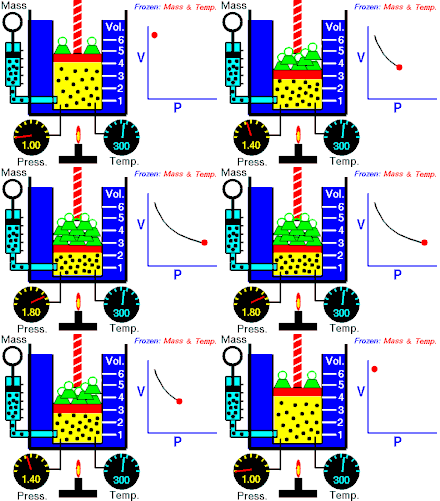
Boyle’s law states that at constant temperature for a fixed mass, the absolute pressure and the volume of a gas are inversely proportional. The law can also be stated in a slightly different manner, that the product of absolute pressure and volume is always constant.
Most gases behave like ideal gases at moderate pressures and temperatures. The technology of the 1600s could not produce high pressures or low temperatures. Hence, the law was not likely to have deviations at the time of publication. As improvements in technology permitted higher pressures and lower temperatures, deviations from the ideal gas behavior would become noticeable, and the relationship between pressure and volume can only be accurately described employing real gas theory.[7] The deviation is expressed as the compressibility factor.
Robert Boyle (and Edme Mariotte) derived the law solely on experimental grounds. The law can also be derived theoretically based on the presumed existence of atoms and molecules and assumptions about motion and perfectly elastic collisions (see kinetic theory of gases). These assumptions were met with enormous resistance in the positivist scientific community at the time however, as they were seen as purely theoretical constructs for which there was not the slightest observational evidence.
Daniel Bernoulli in 1738 derived Boyle's law using Newton's laws of motion with application on a molecular level. It remained ignored until around 1845, when John Waterston published a paper building the main precepts of kinetic theory; this was rejected by the Royal Society of England. Later works of James Prescott Joule, Rudolf Clausius and in particular Ludwig Boltzmann firmly established the kinetic theory of gases and brought attention to both the theories of Bernoulli and Waterston.[8]
The debate between proponents of Energetics and Atomism led Boltzmann to write a book in 1898, which endured criticism up to his suicide in 1906.[8] Albert Einstein in 1905 showed how kinetic theory applies to the Brownian motion of a fluid-suspended particle, which was confirmed in 1908 by Jean Perrin.
Wiki
Conservation of Energy
The law of conservation of energy is an empirical law of physics. It states that the total amount of energy in an isolated system remains constant over time (is said to be conserved over time). A consequence of this law is that energy can neither be created nor destroyed, it can only be transformed from one state to another. The only thing that can happen to energy in a closed system is that it can change form, for instance chemical energy can become kinetic energy.
Albert Einstein's theory of relativity shows that energy and mass are the same thing, and that neither one appears without the other. Thus in closed systems, both mass and energy are conserved separately, just as was understood in pre-relativistic physics. The new feature of relativistic physics is that "matter" particles (such as those constituting atoms) could be converted to non-matter forms of energy, such as light; or kinetic and potential energy (example: heat). However, this conversion does not affect the total mass of systems, since the latter forms of non-matter energy still retain their mass through any such conversion.[1]
Today, conservation of “energy” refers to the conservation of the total system energy over time. This energy includes the energy associated with the rest mass of particles and all other forms of energy in the system. In addition the invariant mass of systems of particles (the mass of the system as seen in its center of mass inertial frame, such as the frame in which it would need to be weighed), is also conserved over time for any single observer, and (unlike the total energy) is the same value for all observers. Therefore, in an isolated system, although matter (particles with rest mass) and "pure energy" (heat and light) can be converted to one another, both the total amount of energy and the total amount of mass of such systems remain constant over time, as seen by any single observer. If energy in any form is allowed to escape such systems (see binding energy) the mass of the system will decrease in correspondence with the loss.
A consequence of the law of energy conservation is that perpetual motion machines can only work perpetually if they deliver no energy to their surroundings. If such machines produce more energy than is put into them, they must lose mass and thus eventually disappear over perpetual time, and are therefore not possible
Wiki
Wednesday, May 26, 2010
Fluid Statics

Fluid statics (also called hydrostatics) is the science of fluids at rest, and is a sub-field within fluid mechanics. The term usually refers to the mathematical treatment of the subject. It embraces the study of the conditions under which fluids are at rest in stable equilibrium. The use of fluid to do work is called hydraulics, and the science of fluids in motion is fluid dynamics.
Due to the fundamental nature of fluids, a fluid cannot remain at rest under the presence of a shear stress. However, fluids can exert pressure normal to any contacting surface. If a point in the fluid is thought of as an infinitesimally small cube, then it follows from the principles of equilibrium that the pressure on every side of this unit of fluid must be equal. If this were not the case, the fluid would move in the direction of the resulting force. Thus, the pressure on a fluid at rest is isotropic; i.e., it acts with equal magnitude in all directions. This characteristic allows fluids to transmit force through the length of pipes or tubes; i.e., a force applied to a fluid in a pipe is transmitted, via the fluid, to the other end of the pipe.
This concept was first formulated, in a slightly extended form, by the French mathematician and philosopher Blaise Pascal in 1647 and would later be known as Pascal's law. This law has many important applications in hydraulics.
Any body of arbitrary shape which is immersed, partly or fully, in a fluid will experience the action of a net force in the opposite direction of the local pressure gradient. If this pressure gradient arises from gravity, the net force is in the vertical direction opposite that of the gravitational force. This vertical force is termed buoyancy or buoyant force and is equal in magnitude, but opposite in direction, to the weight of the displaced fluid.
In the case of a ship, for instance, its weight is balanced by shear force from the displaced water, allowing it to float. If more cargo is loaded onto the ship, it would sink more into the water - displacing more water and thus receive a higher buoyant force to balance the increased weight.
Discovery of the principle of buoyancy is attributed to Archimedes.
Liquids can have free surfaces at which they interface with gases, or with a vacuum. In general, the lack of the ability to sustain a shear stress entails that free surfaces rapidly adjust towards an equilibrium. However, on small length scales, there is an important balancing force from surface tension.
When liquids are constrained in vessels whose dimensions are small, compared to the relevant length scales, surface tension effects become important leading to the formation of a meniscus through capillary action. This capillary action has profound consequences for biological systems as it is part of one of the two driving mechanisms of the flow of water in plant xylem, the transpirational pull.
Wiki
Fluid Dynamics
In physics, fluid dynamics is a sub-discipline of fluid mechanics that deals with fluid flow—the natural science of fluids (liquids and gases) in motion. It has several subdisciplines itself, including aerodynamics (the study of air and other gases in motion) and hydrodynamics (the study of liquids in motion). Fluid dynamics has a wide range of applications, including calculating forces and moments on aircraft, determining the mass flow rate of petroleum through pipelines, predicting weather patterns, understanding nebulae in interstellar space and reportedly modeling fission weapon detonation. Some of its principles are even used in traffic engineering, where traffic is treated as a continuous fluid.
The Fluid dynamics offers a systematic structure that underlies these practical disciplines, that embraces empirical and semi-empirical laws derived from flow measurement and used to solve practical problems. The solution to a fluid dynamics problem typically involves calculating various properties of the fluid, such as velocity, pressure, density, and temperature, as functions of space and time.
Historically, hydrodynamics meant something different than it does today. Before the twentieth century, hydrodynamics was synonymous with fluid dynamics. This is still reflected in names of some fluid dynamics topics, like magnetohydrodynamics and hydrodynamic stability—both also applicable in, as well as being applied to, gases.oundational axioms of fluid dynamics are the conservation laws, specifically, conservation of mass, conservation of linear momentum (also known as Newton's Second Law of Motion), and conservation of energy (also known as First Law of Thermodynamics). These are based on classical mechanics and are modified in quantum mechanics and general relativity. They are expressed using the Reynolds Transport Theorem.
In addition to the above, fluids are assumed to obey the continuum assumption. Fluids are composed of molecules that collide with one another and solid objects. However, the continuum assumption considers fluids to be continuous, rather than discrete. Consequently, properties such as density, pressure, temperature, and velocity are taken to be well-defined at infinitesimally small points, and are assumed to vary continuously from one point to another. The fact that the fluid is made up of discrete molecules is ignored.
For fluids which are sufficiently dense to be a continuum, do not contain ionized species, and have velocities small in relation to the speed of light, the momentum equations for Newtonian fluids are the Navier-Stokes equations, which is a non-linear set of differential equations that describes the flow of a fluid whose stress depends linearly on velocity gradients and pressure. The unsimplified equations do not have a general closed-form solution, so they are primarily of use in Computational Fluid Dynamics. The equations can be simplified in a number of ways, all of which make them easier to solve. Some of them allow appropriate fluid dynamics problems to be solved in closed form.
Wiki
Metrology
Metrology is defined by the International Bureau of Weights and Measures (BIPM) as "the science of measurement, embracing both experimental and theoretical determinations at any level of uncertainty in any field of science and technology."[1] The ontology and international vocabulary of metrology (VIM) is maintained by the International Organisation for Standardisation.
A core concept in metrology is (metrological) traceability, defined as "the property of the result of a measurement or the value of a standard whereby it can be related to stated references, usually national or international standards, through an unbroken chain of comparisons, all having stated uncertainties." The level of traceability establishes the level of comparability of the measurement: whether the result of a measurement can be compared to the previous one, a measurement result a year ago, or to the result of a measurement performed anywhere else in the world.
Traceability is most often obtained by calibration, establishing the relation between the indication of a measuring instrument and the value of a measurement standard. These standards are usually coordinated by national laboratories: National Institute of Standards and Technology (USA), National Physical Laboratory, UK, etc.
Tracebility, accuracy, precision, systematic bias, evaluation of measurement uncertainty are critical parts of a quality management system.
Mistakes can make measurements and counts incorrect. If there are no mistakes, all counts will be exactly correct. Even if there are no mistakes, nearly all measurements are still inexact. The term 'error' is reserved for that inexactness, also called measurement uncertainty. Among the few exact measurements are:
The absence of the quantity being measured, such as a voltmeter with its leads shorted together: the meter should read zero exactly.
Measurement of an accepted constant under qualifying conditions, such as the triple point of pure water: the thermometer should read 273.16 kelvin (0.01 degrees Celsius, 32.018 degrees Fahrenheit) when qualified equipment is used correctly.
Self-checking ratio metric measurements, such as a potentiometer: the ratio in between steps is independently adjusted and verified to be beyond influential inexactness.
All other measurements either have to be checked to be sufficiently correct or left to chance. Metrology is the science that establishes the correctness of specific measurement situations. This is done by anticipating and allowing for both mistakes and error. The precise distinction between measurement error and mistakes is not settled and varies by country. Repeatability and reproducibility studies help quanitfy the precision: one common method is an ANOVA Gauge R&R study.
Calibration is the process where metrology is applied to measurement equipment and processes to determine conformity with a known standard of measurement, usually tracable to a national standards board.
Wiki
